
DID JESUS RISE FROM THE DEAD?
Everything turns on what happened in
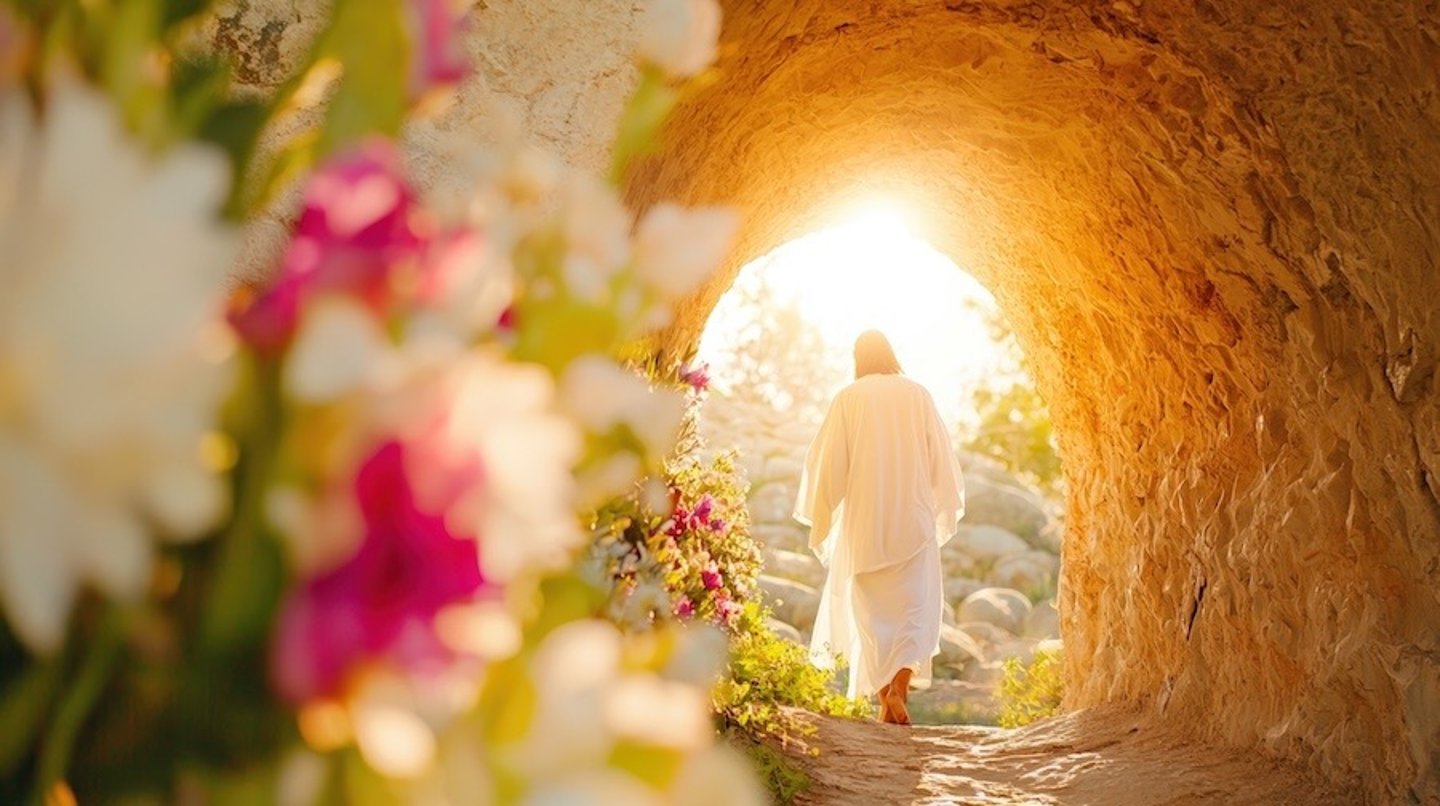
that empty tomb.
The resurrection is often spoken of as a story, yet history carries details that ask far more of us than a simple tale. Something happened in that early morning world of stone and silence, and whatever occurred reshaped ordinary men and women so deeply that fear dissolved into courage and grief into a steady fire of conviction.


Certain moments in history ask us to pause and consider whether the world witnessed an event so unusual that every explanation which tries to soften it grows thin. The empty tomb, the testimony of startled followers who later risked everything, the silence of political and religious leaders who had every reason to shut the message down at once, and the absence of a body which would have ended the movement instantly, all stand together in a way that refuses to be dismissed lightly.
Here we take these elements seriously. It traces the historical details that still speak with quiet clarity, and it gives space as well to the hesitations and challenges, because any responsible search for truth welcomes both confidence and caution. The goal here is simple.
If Christ rose, the implications reach into every life on earth. If he did not, the movement that carries his name rests on a foundation that should have crumbled long ago.
We follow the evidence carefully in order to understand why generations of thoughtful people have believed that the world changed in a borrowed tomb outside Jerusalem, and why this event remains as compelling today as it was to those who first saw the stone rolled away.
The Historical Framework of Jesus’ Death and Burial
The story begins with something the ancient world recorded with unusual clarity. Jesus of Nazareth lived under Roman rule, and Rome kept its authority through order, discipline, and the unyielding certainty of punishment. When their records speak of an execution under Pontius Pilate, historians across belief systems generally agree that this event stands firmly within history rather than legend. The death of Jesus is anchored in the writings of both Roman and Jewish sources, which means the conversation does not begin with myth, it begins with an actual man who faced an actual Roman crucifixion.
The burial that followed carries its own quiet weight. The accounts tell us that Joseph of Arimathea, a respected member of the council, asked for the body and placed it in a new tomb cut from rock. This detail emerges across early Christian texts with a kind of steady simplicity that invites attention. A known tomb, belonging to a known man, stands very differently from the vague resting places that often appear in ancient stories. A specific location brings responsibility, because its existence allows for verification, and the earliest Christians proclaimed the resurrection within walking distance of that very place.
This matters deeply. A public claim offered in the same city where the events took place carries enormous risk if the claim is false. Anyone who wanted to silence the disciples could have travelled to the tomb and responded with a simple act of evidence. That such a response never appears in any credible record becomes one of the earliest puzzle pieces in this story.
The burial grounds the narrative in the soil of history, because everything that follows connects back to the reality of that sealed stone chamber. If Jesus remained inside, the Christian faith should never have survived its first breath. If he did not remain inside, something must account for the absence that shaped the courage of men and women who had once fled in fear. Every argument eventually returns to that moment when the world awakened to a tomb that no longer held its prisoner.
The Empty Tomb and the Questions It Raises
The discovery of the empty tomb stands as one of the most striking elements in the early Christian account. The moment unfolds quietly. Women arrive at dawn with spices, prepared for the simple tenderness of mourning, and instead find an opening where finality should have barred the way. Their grief carried expectation rather than hope, which means they did not approach the tomb to confirm a miracle. They went there to honour the dead.
The presence of women at the centre of this moment carries immense historical weight. Their testimony in that culture held little legal strength, and their voices were often dismissed in matters of public reliability. If the early Christians wished to invent a story, they would never choose witnesses whose words could be rejected so easily. The choice of these women appears in the earliest accounts with a quiet sincerity that resists every attempt to shape it into careful strategy. Their inclusion signals truth rather than craft, because a fabricated story would have placed respected men at the scene to establish credibility. The fact that the narrative honours women with this role reveals a detail that rises above invention.
If the tomb remained full, the message of resurrection could have been silenced by the simple act of presenting a body. Neither the Roman authorities nor the religious leaders had any interest in allowing a new movement to rise around a crucified teacher. Their motivation to end the proclamation was immense. Yet history preserves no credible attempt to display a corpse. The silence becomes louder than many realise, because silence in such a moment means they faced a problem they could not resolve.
Scholars across centuries have recognised the difficulty this creates for the claim that the disciples invented the story. A falsified resurrection would collapse instantly once confronted with evidence from the tomb. The absence of such evidence becomes one of the most uncomfortable realities for any theory seeking a natural explanation.
The empty tomb asks a question that refuses to fade. Either Rome and the leaders of Jerusalem failed to perform the single action that would have ended Christianity before it began, or the tomb no longer held the one who had been laid inside. That tension hangs over every analysis of the resurrection, and every attempt to explain it must address the stubborn simplicity of an open, unoccupied resting place.
The Transformation of the Disciples
The disciples entered the week of the crucifixion with trembling hearts. They witnessed arrest, torture, and death. They watched the collapse of every expectation they carried. Their fear was real, their disappointment profound, and their despair heavy enough to scatter them into hiding. These details reveal the kind of men they were before the resurrection. They were ordinary, frightened people who had lost their teacher and seen their dreams buried beneath a stone.
Something changed them. The shift was not subtle. Men who once fled out of feat began to speak in public squares with a boldness that astonished everyone who heard them. They proclaimed the resurrection in the city where the crucifixion occurred, and they did so without hesitation. They faced imprisonment, beatings, and threats, and still their conviction grew. This transformation does not resemble the behaviour of individuals who attempted to deceive the world. Deception collapses under pressure. These men stood in places that demanded courage which cannot be faked.
Many of them suffered for this testimony. Ancient records and church tradition preserve accounts of imprisonment, hardship, and execution faced by those who carried this message into the world. Their willingness to endure suffering reveals the depth of their certainty. Something happened that turned their grief into unshakable joy, and their fear into strength that felt almost foreign to their earlier selves.
Any honest study of the resurrection must explain this transformation. Fear does not become courage through imagination. Grief does not become joy through self-deception. Something touched these men that reached deeper than despair, and the earliest Christian writings insist that the risen Christ stood before them and spoke with the same voice they once heard by the Sea of Galilee.
Why the Stolen Body Theory Collapses Under Its Own Weight
As soon as the empty tomb enters the story, some imagine the simplest explanation must involve human hands. The idea that the disciples stole the body appears in early conversations around the resurrection, which shows that people searched for a natural answer even in the first century. Yet when we examine what such an act would require, the explanation grows weaker with every step.
The disciples had no strength of heart in those hours after the crucifixion. They hid from authorities, confused and overwhelmed. These same men would need to assemble in secret, slip past those guarding the tomb, break a seal placed by those in power, move a heavy stone without drawing the slightest attention, and then remove a body in complete silence. They would also need to carry this plan with enough unity to preserve the lie through interrogations, threats, and the risk of death. Such a picture strains the imagination, because frightened men with broken hopes do not suddenly transform into master strategists.
If the guards failed in their duty, the consequences for them would have been severe. Ancient Roman discipline treated neglect with uncompromising severity. A guard who abandoned his post faced punishment that often ended in death. This creates another question. How could an entire group of disciplined soldiers fall asleep at the same time while stationed at a tomb secured at the request of political and religious leaders. A coordinated sleep among trained military men does not match what we know of Roman responsibility.
Even the claim that a theft occurred has its own contradiction. If those guarding the tomb slept, then they could not have witnessed any theft. Their explanation turns in circles, which reveals the weakness of the accusation. A story built on such uncertainty lacks the kind of coherence that truth usually carries.
The stolen body theory appeals to those who feel uneasy with the miracle at the heart of the resurrection. Yet once the details of that theory stand in the light, the structure cannot bear its own weight. Everything required of the disciples feels out of character for men who trembled behind closed doors, and everything required of the guards feels out of character for a force shaped by strict military order. The theory creates more problems than it resolves, and history rarely rewards explanations that demand the impossible from ordinary people.
The Implausibility of the Swoon Hypothesis
Another attempt to avoid the resurrection insists that Jesus never truly died, that he survived the crucifixion and later revived inside the tomb. This idea initially offers a sense of simplicity, yet once we walk through what crucifixion involved, the simplicity fades.
Roman executioners carried deep familiarity with death. Their work did not rely on guesswork. A crucified man endured hours of agony, blood loss, suffocation, and severe physical trauma. Those responsible for the process understood the signs of life and the signs of death with a level of experience that made mistakes unlikely. Ancient descriptions of the spear thrust to Jesus’ side, which produced a flow of blood and a clear watery fluid, show a final confirmation that the execution had reached its end. Medical understanding today recognises that such a mixture appears when the heart and surrounding cavity have ruptured and life has already passed. The soldiers saw this, and they knew exactly what it meant. This detail stands as one of the strongest indications that they recognised true death rather than the faint pulse of a surviving man.
Imagine then a body that had endured such suffering. He would need to revive in a cold tomb without care, upright himself, remove grave wrappings, push aside a large stone, escape a guarded entrance, travel on injured feet, and then appear before his disciples in a condition convincing enough to inspire joy rather than sorrow. The picture becomes almost painful to imagine. A body in that state could never have created the unwavering certainty seen in the early Christian testimony.
Even if he somehow escaped, this wounded figure would need to vanish from the historical record entirely, because the early church never described a barely living survivor. They spoke of encounters with someone who carried the strength and clarity of life restored. A man on the edge of death cannot create such courage, and the swoon hypothesis fails here with unmistakable clarity. It requires the impossible from the human body and even more from the human mind.
If Jesus lived through crucifixion, then the earliest Christians built their faith on a fragile man whose suffering continued. Yet their records reveal the opposite. They describe meetings with someone whose presence lifted fear, healed despair, and filled them with a joy that felt larger than their grief. Nature itself warns us that such transformation cannot come from a dying body. It can only come from a risen one.
The Silence of Rome and Jerusalem
The absence of a body did not serve the interests of those who opposed Jesus. Both the Roman authorities and the religious leaders understood that a movement centered on a risen teacher could ignite unrest, challenge established structures, and draw crowds hungry for hope. They had every reason to remove this claim from the public conversation as quickly as possible.
The simplest and most decisive response would have been the presentation of a body. It would have ended every sermon preached by the disciples. It would have extinguished courage among the followers. It would have dissolved the entire message in a single moment. Yet no such counteraction appears in any reliable record. The silence speaks with a clarity that cannot be ignored.
This does not mean they lacked interest. Their earlier efforts reveal deep concern about the influence of Jesus. They feared unrest, they feared spiritual authority that challenged their own, and they feared the loyalty he drew from crowds. These motives create a strong expectation that they would act decisively if an opportunity arose to crush the new proclamation. Their inability to do so becomes one of the most striking aspects of early Christian history.
Such silence invites reflection. It suggests that those in power faced a problem they could not resolve. They could not produce a body because the tomb no longer held one. Whether they understood the reason for this or fought against it internally remains unknown. What we do know is that the absence of evidence for their opposition becomes evidence of its own kind.
The Early Surge of Christian Faith
A message that rests upon a fragile deception cannot reshape the ancient world. A belief that rises from confusion cannot sustain courage under persecution. Yet the early Christian movement grew with remarkable strength, spreading through cities, villages, and households, carried by ordinary people with extraordinary conviction.
Other faiths have also travelled across cultures, yet their journeys follow very different paths. Islam emerged centuries later, deeply shaped by the world Christianity had already transformed, and its growth is tied to political expansion, cultural inheritance, and systems of power that carried its message forward. Buddhism spread through philosophical schools, royal patronage, and cultural adoption, yet its rise depends on teachings that do not require a moment in history to be true.
Christianity stands alone here, because its entire foundation rests on a single event that either happened in a specific garden tomb or did not happen at all. The faith does not grow through ideas alone. It grows through a claim rooted in time, witnessed by specific people, and proclaimed at the cost of suffering. This difference becomes essential, because Christianity does not invite the world into a philosophy. It invites the world into a historical reality that cannot be reshaped without losing its meaning.
These men and women proclaimed that they had encountered life in a way that reached deeper than grief and stronger than fear. Their courage did not arise from inherited tradition or philosophical reflection. It grew from the certainty that the one they loved had walked out of death and stood before them with a presence stronger than suffering. This kind of conviction cannot be created through imagination, because imagination collapses when hardship arrives. The earliest Christians spoke with the calm confidence of eyewitnesses rather than theorists. They preached in marketplaces, synagogues, and private homes with a steadiness that surprised both friends and enemies, and their message carried a simplicity that never changed. Christ died, Christ rose, and Christ appeared. These three truths shaped every sermon and every letter. Nothing in their behaviour suggests the fragile fire of a borrowed idea. Everything points to the strength that comes only from encountering someone who changed the meaning of death itself.
The early Christian writings reveal this unity with remarkable consistency. The resurrection stands at the centre of every teaching and forms the heartbeat of every community that emerged from those first witnesses. They did not gather around ethical improvement or spiritual insight. They gathered around a living Christ who changed their understanding of God, humanity, and history. Their message travelled into a world familiar with many philosophies, yet none of those philosophies claimed that a crucified man had stepped out of a sealed tomb. This proclamation faced suspicion, resistance, and at times open hostility, yet it continued to spread because those who carried it believed that they were telling the truth.
The cost of this belief was high, and such a cost exposes the difference between a comforting idea and a conviction grounded in reality. Ideas fade when threatened. Convictions born from encounter endure through fire.
When historians examine movements that survived across centuries, they often look for a unifying event strong enough to carry the weight of devotion. The resurrection stands as that event in Christian history, because nothing else explains why a group of frightened disciples transformed into witnesses whose confidence shaped an entire civilisation.
The Psychological and Sociological Implausibility of Mass Deception
Every generation has searched for meaning, and from that search many belief systems have risen. Some emerged from the insight of a single teacher whose words offered a path toward inner peace. Others grew from centuries of cultural memory, shaping entire nations through stories, customs, and inherited rituals. A few began through political influence, where rulers carried a message into new territories as part of their expansion. These movements reveal something important about human nature. People often gather around ideas that promise stability, identity, or wisdom. They follow voices that seem steady, they imitate the practices of their families, and they absorb the teachings passed from one century to the next. Such developments feel natural, because beliefs formed through philosophy or tradition do not rely on a single event anchored in a specific moment. They grow gradually, carried by cultural rhythm rather than a sudden shock to the world.
When we look at Buddhism, we find a noble and thoughtful system shaped by the reflections of Siddhartha Gautama who sought relief from suffering. His followers embraced his teachings because they offered a peaceful path, a way of understanding the human condition, and a vision of inner awakening. These ideas required no public miracle and no historical claim that could be verified or disproven. They asked for inward transformation rather than allegiance to an event that either happened or did not happen. The growth of Buddhism followed patterns familiar to the ancient world. Teachers travelled, kings approved, communities adopted the practices, and the movement matured through contemplation rather than confrontation.
Other large belief systems reveal similar patterns. They grow through cultural inheritance, philosophical coherence, political strength, or the slow ripening of tradition. People often embrace them because they see beauty in the ideas or comfort in the customs. These movements do not ask their followers to risk their lives for a single claim that could be proven false, except in the Islamic faith where devotion carries great cost, yet even there the message arose centuries after Christ and grew from a vision that reshaped elements of the Christian story rather than from an empty tomb witnessed in real time. Most of them ask for loyalty to teachings, reflection on moral truths, or participation in a shared way of life. Such commitments can be sincere and meaningful, yet they do not resemble the birth of Christianity.
Christianity entered the world in a manner entirely unlike any of these systems. It did not arise through philosophy or through the long memory of a tribe. It did not grow through political power or cultural inheritance. It burst into history through a claim so specific and so vulnerable that it could have collapsed instantly if untrue. Its entire existence rests on a moment in time, when a man publicly executed under Roman authority was laid in a known tomb and later proclaimed alive by those who had once fled in despair. Everything depends on that moment. If the tomb still held his body, the message would have ended at once. If the disciples invented the story, fear would have silenced them when threats and suffering arrived. If they misunderstood what they saw, the movement would have dissolved under the pressure of persecution.
Yet the opposite happened. Men and women who had trembled in confusion suddenly spoke with a clarity that changed entire cities. They carried the message through prisons, beatings, hardship, and death without surrendering its core. They did not spread a philosophy that could be admired without risk. They preached a reality that either stands as truth or falls as deception. The cost they paid reveals the depth of their certainty. People do not suffer willingly for claims they know to be false, and they do not endure hardship for something they merely imagined in a moment of grief. Something touched these witnesses that reached deeper than fear. Something convinced them that death itself had yielded to a greater power.
This difference makes Christianity stand apart from every other major belief system. It does not rest on inherited custom. It does not rest on philosophical development. It rests on a resurrection proclaimed by those who had nothing to gain and everything to lose. The psychological and sociological force behind such a movement cannot be explained by deception or confusion. Ordinary people do not risk their lives for a fragile illusion. Only truth creates such courage. Only encounter creates such steadfastness. And only an empty tomb can give birth to a faith strong enough to outlive empires, transform cultures, and carry hope across centuries that never cease to test its foundation.
Why the Resurrection Remains the Most Coherent Explanation
All theories that seek to explain the empty tomb without resurrection face difficulties that become heavier the longer they are examined. They require men to act against their character, soldiers to abandon their discipline, and nature to suspend the limits of the human body in ways that contradict everything we know about suffering and death. They also require entire communities to commit themselves to a message rooted in deceit or confusion, even though such foundations rarely survive pressure.
The resurrection, on the other hand, brings every detail together with a sense of coherence that mirrors the shape of the accounts themselves. A body no longer in the tomb, guards unable to explain an absence, disciples transformed into courageous witnesses, authorities unable to silence the message, and a movement that expanded across cultures and generations. These elements form a pattern that feels consistent with an event capable of turning the world in a new direction.
This does not mean all questions vanish. History always contains gaps created by time, limited sources, and the complexity of human experience. Yet even within those gaps, the evidence leans toward something extraordinary. The resurrection stands as the only explanation that honours every aspect of the story without forcing the facts into shapes they cannot hold.
Those who approach this question with open hearts soon discover that they are not dealing with a myth designed to comfort the weary. They are dealing with a claim that carries strength, clarity, and a kind of beauty that draws the soul toward deeper reflection. If the resurrection happened, then death does not speak the final word. If it happened, then the world carries a hope that stretches beyond suffering, history, and time itself.
A Closing Reflection
There comes a moment in every search for truth when evidence is no longer an arrangement of ideas. It becomes a question that turns toward us and waits for a response. The resurrection stands in that place. It does not force itself upon anyone, yet it refuses to sit quietly in the corner of history, because too much depends on it. A man crucified under Roman authority, buried in a known tomb, mourned by frightened followers, and then proclaimed alive by those same followers with unshakable courage, cannot be treated as a simple legend. Something happened. The world felt the impact, and history still carries the imprint.
Every attempt to explain the empty tomb without resurrection must stretch human behaviour, military discipline, psychological endurance, and historical silence beyond what they can reasonably bear. These explanations promise simplicity, yet cannot account for the unity of the facts. The resurrection, on the other hand, welcomes every detail and holds them together with a coherence that continues to astonish those who search with honest minds.
The earliest witnesses speak through time with voices shaped by awe rather than strategy. They were not philosophers crafting an idea. They were people who encountered someone they believed had overcome death itself. Their courage did not rise from persuasion, but rose from a real presence. They walked with him after his tomb stood empty, and they carried that certainty into a world that often met them with resistance.
So the question of Jesus' resurrection matters because it reaches beyond the intellect.
If Christ rose, then suffering carries meaning, death loses its power, and hope becomes more than a wish.
If he rose, then the deepest longings within the human heart rest upon a foundation stronger than fear.
If he rose, then the world holds a truth that invites every person to step closer and listen.
No one can answer this question for another. Each soul must stand before the evidence and the silence, the voices of history and the weight of personal longing, and then decide what story fits the world with the greatest honesty. The resurrection invites that decision with gentleness rather than force. It offers strength without intimidation and truth without arrogance. It asks for attention in a world filled with noise, and it rewards those who seek with an understanding that reaches far beyond the boundaries of time.
Many generations have knelt before this moment and found that the evidence carries more than information. It carries life. And once that life is seen, everything else becomes clearer, because the world suddenly feels less like a place ruled by endings and more like a place shaped by a victory that unfolded in a quiet garden at dawn.


Quiet Truths was founded in 2017 as Truth Talks on the Gold Coast, Australia, and is now based in Queenstown, New Zealand.
© 2026 Quiet Truths. All rights reserved
FAITHFUL SAINTS
WHY IS CHRISTIANITY DIFFERENT?
ARE SPIRITUAL EXPERIENCES EQUAL?
WHAT IS HEAVEN LIKE?